
Showing posts with label presentations. Show all posts
Showing posts with label presentations. Show all posts
Monday, June 10, 2019


Thursday, October 04, 2018

Monday, May 28, 2018
Poster: Acting Like a Scientist - Using Video to Generate Questions
Young children are naturally curious about their world and have a reputation for asking their parents an endless number
of questions. At some point in their development, their willingness to ask questions usually stops and this usually occurs
when they go to school. In school, students are asked questions by their teacher and when they are allowed to ask a
question, it is usually addressed to the teacher about something they do not understand related to a taught learning
objective. When students are given the ability to generate the questions for discussion, they act like scientists, a practice
called for in the Next Generation Science Standards. In this poster, you will see how I used videos posted on the Internet as
a forced connection that helped my students generate questions for discussion. You will see that some questions could be
answered by other students and those that could not, became learning objectives for my science units.
Friday, May 25, 2018
Transforming Pedagogical Content Knowledge through Technology
Based on years of observing their previous teachers and professors, graduate students enter educational programs with preconceptions about how to teach. Technology has the potential to transform content for diverse learners (Rose & Meyer, 2002; Angeli & Valanides, 2008), but most graduate students do not know how to teach with technology (Ertmer, 2005). This presentation will explore how graduate students increased their ability to help diverse learners and thus, their pedagogical content knowledge. Blogs, Wikispaces, and Storybird will be the featured technologies.
Presenters: Sherri Weber, Jing Zhang, Christopher Shively

Presenters: Sherri Weber, Jing Zhang, Christopher Shively

Saturday, May 12, 2018
Taking the Next Step- What Should Happen after My Students Collect Science Data
Dr. Shively’s talk uses sociocultural theory to explain why seven pre-service science teachers did not design and teach science lessons that enabled their kids to communicate with each other about the data they collected during the science lessons. The pre-service science teachers in this talk were young students when the authors of the National Science Education Standards encouraged science teachers to place more emphasis on having kids draw conclusions from the data they collected, formulate scientific arguments and communicate those arguments to their classmates (NRC, 1996). If the science teachers of the 1990s and 2000s had followed the suggestions outlined in the standards, the pre-service teachers might have designed lessons that enabled their own students to talk about their data because they would have observed this method of teaching. Dr. Shively explains how grades and high stakes exams contributed to this omission in these science lessons.


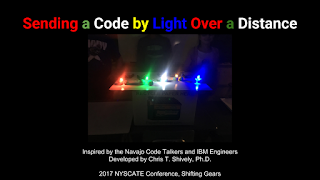
Conference Presentation: Sending a Code by Light Over a Distance
What do the Navajo Code Talkers of World War II and IBM computer engineers in the 1960s have in common? Well, they both engineered codes that enabled people to communicate messages over a distance. They were also the inspiration for a STEAM unit designed to communicate messages over a distance. They were also the inspiration for a STEAM unit designed to teach elementary school students and pre-service teachers concepts about engineering, energy and matter. In this presentation, you will see how the old ideas of the Navajo Code Talkers and computer engineers were used by students to engineer "squishy circuit" devices that communicated a Navajo word using only light. You will also find out how Chemistry concepts can be taught to young children using "squishy circuits" and computer simulations.

Conference Presentation: How Teacher Preparation is Being Transformed by Digital Technologies at an Urban Comprehensive College
This is a description of my portion of an AERA presentation with Jing Zhang Ph.D., Sherri Weber Ph.D., and Dr. Jevon Hunter Ph.D. in Philadelphia, PA. Our presentation is below my summary.
Examining Graduate Students’ Technological Pedagogical and Content Knowledge Using a Wiki During an Online Course
Objectives
Based on years of observing teachers, graduate students enter educational programs with preconceptions about how to teach with technology (Ertmer, 2005; Angeli & Valanides, 2008). Their observations might not have contributed to their understanding of how to integrate technology because teaching is a “highly complicated form of problem-solving and problem seeking” (Koehler & Mishra, 2008, p. 3) involving several interacting forms of knowledge. The results of a study that examined the development of graduate students’ knowledge of what technology is available, where technology can be used in the curriculum, and how to teach with it will be shared. This analysis is important as graduate students’ evolving pedagogy has the potential to transform content learning for diverse learners (Rose & Meyer, 2002; Angeli et al., 2008).
Conceptual Framework
Two conceptual frameworks informed this qualitative study: 1.) TPaCK known as technological, pedagogical and content knowledge (Koehler & Mishra, 2008); and 2.) Sociocultural Theory. TPaCK is the intersection of three bases of knowledge: technology, pedagogy and content (2008). Sociocultural theory was used because the graduate students’ mediated actions were anchored in the milieu of all their learning experiences (Wertsch, 1993).
Methodology
Two questions guided this one-year study with eighteen graduate students during an advanced, online, educational technology course: 1.) how do graduate students interpret the use of technological tools that have the potential to support pedagogical strategies presented in the context of a university technology course? 2.) in what ways, if any, does the use of a wiki affect the development of a graduate students’ technological, pedagogical, and content knowledge? Data Sources Three sources of data were collected from each graduate student: 1.) a technology-infused lesson plan; 2.) a self-reflection of the lesson taught in an asynchronous manner to a teaching partner; and 3.) feedback provided to his or her teaching partner about their lesson using sentence starters to encourage collaborative talk about TPaCK.
Results
Findings demonstrated the pedagogical potential of using a wiki to facilitate the co-construction of TPaCK in an online course. Lesson plans, reflections and feedback data revealed that graduate students were able to identify many affordances and constraints of the technologies they used which led to their development of technological pedagogical knowledge but not their technological, pedagogical, and content knowledge. This might have been caused by their lack of teaching experience and/or their observations of inadequate teaching with technology. Data suggested that they did not understand what made the concepts they were teaching difficult or easy for the grade level designated for their lesson
Scholarly Significance
The asynchronous nature of the wiki gave the graduate students time to read and think about the pedagogical moves written in their teaching partner’s lesson plan and respond to the feedback given to them at their own pace. This work demonstrates that the use of a wiki, an innovative pedagogical practice, is not just a medium that can transmit information, but it can also be used as a “cognitive partner” (Angeli et al., 2008) to support the co-construction of knowledge.

Examining Graduate Students’ Technological Pedagogical and Content Knowledge Using a Wiki During an Online Course
Objectives
Based on years of observing teachers, graduate students enter educational programs with preconceptions about how to teach with technology (Ertmer, 2005; Angeli & Valanides, 2008). Their observations might not have contributed to their understanding of how to integrate technology because teaching is a “highly complicated form of problem-solving and problem seeking” (Koehler & Mishra, 2008, p. 3) involving several interacting forms of knowledge. The results of a study that examined the development of graduate students’ knowledge of what technology is available, where technology can be used in the curriculum, and how to teach with it will be shared. This analysis is important as graduate students’ evolving pedagogy has the potential to transform content learning for diverse learners (Rose & Meyer, 2002; Angeli et al., 2008).
Conceptual Framework
Two conceptual frameworks informed this qualitative study: 1.) TPaCK known as technological, pedagogical and content knowledge (Koehler & Mishra, 2008); and 2.) Sociocultural Theory. TPaCK is the intersection of three bases of knowledge: technology, pedagogy and content (2008). Sociocultural theory was used because the graduate students’ mediated actions were anchored in the milieu of all their learning experiences (Wertsch, 1993).
Methodology
Two questions guided this one-year study with eighteen graduate students during an advanced, online, educational technology course: 1.) how do graduate students interpret the use of technological tools that have the potential to support pedagogical strategies presented in the context of a university technology course? 2.) in what ways, if any, does the use of a wiki affect the development of a graduate students’ technological, pedagogical, and content knowledge? Data Sources Three sources of data were collected from each graduate student: 1.) a technology-infused lesson plan; 2.) a self-reflection of the lesson taught in an asynchronous manner to a teaching partner; and 3.) feedback provided to his or her teaching partner about their lesson using sentence starters to encourage collaborative talk about TPaCK.
Results
Findings demonstrated the pedagogical potential of using a wiki to facilitate the co-construction of TPaCK in an online course. Lesson plans, reflections and feedback data revealed that graduate students were able to identify many affordances and constraints of the technologies they used which led to their development of technological pedagogical knowledge but not their technological, pedagogical, and content knowledge. This might have been caused by their lack of teaching experience and/or their observations of inadequate teaching with technology. Data suggested that they did not understand what made the concepts they were teaching difficult or easy for the grade level designated for their lesson
Scholarly Significance
The asynchronous nature of the wiki gave the graduate students time to read and think about the pedagogical moves written in their teaching partner’s lesson plan and respond to the feedback given to them at their own pace. This work demonstrates that the use of a wiki, an innovative pedagogical practice, is not just a medium that can transmit information, but it can also be used as a “cognitive partner” (Angeli et al., 2008) to support the co-construction of knowledge.
[presentation link - in pdf format]
Friday, May 11, 2018
Conference Presentation: PDSF + (TCs+BSCP) = SL; Tracing the Development of a STEM Unit
When Professional Development School faculty (PDSF) work with teacher candidates (TSs) and a SUNY Buffalo State professor (BSCP), fifth grade students learn (SL) how chemistry and physics influence an engineering project The content of this presentation explains how a summer conference idea from a Lake Shore 1st grade and 5th grade teacher and elementary principal led to the development and implementation of a STEM unit. In the fall 2015—spring 2016 semesters, Buffalo State teacher candidates and a math/science methods professor planned the unit and tried out the lessons.
When the unit was ready, a 5th-grade teacher, a Buffalo State TC, and the college professor taught STEM unit lessons to 5th graders and helped them engineer “squishy,” electric circuits that sent messages over a distance using light.
Presenters: Dr. Christopher Shively, Mary Brumagin, and Jill Clark

When the unit was ready, a 5th-grade teacher, a Buffalo State TC, and the college professor taught STEM unit lessons to 5th graders and helped them engineer “squishy,” electric circuits that sent messages over a distance using light.
Presenters: Dr. Christopher Shively, Mary Brumagin, and Jill Clark

Conference Presentation: Does Actual Teaching Mirror the Task 4 Requirement of the edTPA Assessment? How aligned to actual teaching is the edTPA assessment?
In this presentation, a teacher candidate, Samantha Hoggard, described the teaching task assigned to her by her cooperating teacher. She was asked to “grade” math fact fluency tests for several weeks. As she methodically scrutinized the data, Samantha unknowingly mimicked many of the Task 4 requirements of the edTPA assessment. This presentation will highlight the connections between real teaching and Task 4, uncovered by Samantha.
Presenters: Samantha Hoggard and Dr. Chris Shively
Presenters: Samantha Hoggard and Dr. Chris Shively
 |
| 2nd Graders and Ms. Hoggard [link to presentation] |
Conference Presentation: Making Invisible Science Concepts…Visible: “Hands-on” Investigations Are Not Enough
Elementary school students cannot see electrons flowing through a closed electric circuit or the forces acting on a floating boat. When elementary school students participate in “hands-on” investigations regarding these two phenomena, it is very hard for a teacher to know what concepts students have assimilated.
This presentation described how teacher candidates planned, taught, and analyzed three science lessons intended to improve elementary students’ conceptual knowledge of electricity and forces.
Presenters: Kelly Beller, Natalie Galvin, Jenna Murphy, and Dr. Chris Shively
This presentation described how teacher candidates planned, taught, and analyzed three science lessons intended to improve elementary students’ conceptual knowledge of electricity and forces.
Presenters: Kelly Beller, Natalie Galvin, Jenna Murphy, and Dr. Chris Shively
 |
| 4th Grade Student and Natalie Construct a Physical Circuit [link to presentation] |
Important Website
Saturday, April 28, 2018
Conference Presentation: Intellectual Character: A Driving Force Behind the Effective Teaching of the Advanced Placement Computer Science Principles Course
Intellectual Character: A Driving Force Behind the Effective Teaching of the Advanced Placement Computer Science Principles Course
Shively, C., Banerjee, S., Mazur, N., & Zawicki, J. (2018). Intellectual Character: A Driving Force Behind the Effective Teaching of the Advanced Placement Computer Science Principles Course. J. Comput. Sci. Coll., 33(6), 194–196.

Shively, C., Banerjee, S., Mazur, N., & Zawicki, J. (2018). Intellectual Character: A Driving Force Behind the Effective Teaching of the Advanced Placement Computer Science Principles Course. J. Comput. Sci. Coll., 33(6), 194–196.

Tuesday, June 03, 2008
Brooke's May Journal
My daughter Brooke has published her Kindergarten May Journal - because she... I mean I - can ;-)
Subscribe to:
Posts (Atom)