- PATTERNS
- Grades K -2
- Patterns in the natural and human designed world can be observed, used to describe phenomena, and used as evidence.
- Grades 3 - 5
- Patterns of change can be used to make predictions.
- Similarities and differences in patterns can be used to sort and classify natural phenomena and designed products.
- Patterns can be used as evidence to support an explanation.
- Similarities and differences in patterns can be used to sort, classify, communicate and analyze simple rates of change for natural phenomena.
- CAUSE AND EFFECT
- Grades K - 2
- Simple tests can be designed to gather evidence to support or refute student ideas about causes.
- Events have causes that generate observable patterns.
- Grades 3 - 5
- Cause and effect relationships are routinely identified, tested, and used to explain change.
- SCALE, PROPORTION, AND QUANTITY
- Grades 3 - 5
- Observable phenomena exist from very short to very long time periods.
- Natural objects exist from the very small to the immensely large.
- Standard units are used to measure and describe physical quantities such as weight, time, temperature, and volume.
- SYSTEMS AND SYSTEM MODELS
- Grades K - 2
- Systems in the natural and designed world have parts that work together.
- Grades 3 - 5
- A system can be described in terms of its components and their interactions.
- Observable phenomena exist from very short to very long time periods.
- ENERGY AND MATTER
- Grades K - 2
- Objects may break into smaller pieces and be put together into larger pieces, or change shapes.
- Grades 3 - 5
- Energy can be transferred in various ways and between objects.
- Matter is transported into, out of, and within systems.
- STRUCTURE AND FUNCTION
- Grades K - 2
- The shape and stability of structures of natural and designed objects are related to their function(s).
- STABILITY AND CHANGE
- Grades K - 2
- Things may change slowly or rapidly.
- INTERDEPENDENCE OF SCIENCE, ENGINEERING, AND TECHNOLOGY
- Grades K - 2
- People encounter questions about the natural world every day.
- Grades 3 - 5
- Scientific discoveries about the natural world can often lead to new and improved technologies, which are developed through the engineering design process.
- Knowledge of relevant scientific concepts and research findings is important in engineering.
- INFLUENCE OF ENGINEERING, TECHNOLOGY, AND SCIENCE ON SOCIETY AND THE NATURAL WORLD
- Grades K - 2
- People depend on various technologies in their lives; human life would be very different without technology.
- Every human-made product is designed by applying some knowledge of the natural world and is built using materials derived from the natural world.
- Developing and using technology has impacts on the natural world.
- Grades 3 - 5
- Engineers improve existing technologies or develop new ones to increase their benefits (e.g., better artificial limbs), decrease known risks (e.g., seatbelts in cars), and meet societal demands (e.g., cell phones).
- Over time, people’s needs and wants change, as do their demands for new and improved technologies.
Showing posts with label NGSS. Show all posts
Showing posts with label NGSS. Show all posts
Tuesday, December 04, 2018
NGSS Crosscutting Concepts - Organized by Grade Level


Sunday, September 23, 2018

Wednesday, August 15, 2018
Plate Tectonics and Large-Scale System Interactions - a breakdown of this NGSS DCI by Grade Level
All information has been obtained from http://www.nextgenscience.org/overview-dci and the subpages contained under that URL domain.

DCI: Plate Tectonics and Large-Scale System Interactions
(1.) Middle School
- Maps of ancient land and water patterns, based on investigations of rocks and fossils, make clear how Earth’s plates have moved great distances, collided, and spread apart. (MS-ESS2-3)
(2.) 5th-grade students do not study the DCI known as Plate Tectonics and Large-Scale System Interactions
(3.) 4th Grade
- The locations of mountain ranges, deep ocean trenches, ocean floor structures, earthquakes, and volcanoes occur in patterns.
- Most earthquakes and volcanoes occur in bands that are often along the boundaries between continents and oceans.
- Major mountain chains form inside continents or near their edges.
- Maps can help locate the different land and water features areas of Earth. (4-ESS2-2)
(4.) 3rd-grade students do not study the DCI known as Earth Materials and Systems
(5.) 2nd Grade
- Maps show where things are located. One can map the shapes and kinds of land and water in any area. (2-ESS2-2)
(6.) 1st-grade and Kindergarten students do not study the DCI known as Plate Tectonics and Large-Scale System Interactions
Clipart src: https://openclipart.org/detail/162847/volcan-effusif

Earth Materials and Systems - a breakdown of this NGSS DCI by Grade Level
All information has been obtained from http://www.nextgenscience.org/overview-dci and the subpages contained under that URL domain.

DCI: Earth Materials and Systems
(1.) Middle School
- All Earth processes are the result of energy flowing and matter cycling within and among the planet’s systems.
- This energy is derived from the sun and Earth’s hot interior.
- The energy that flows and matter that cycles produce chemical and physical changes in Earth’s materials and living organisms. (MS-ESS2-1)
- The planet’s systems interact over scales that range from microscopic to global in size, and they operate over fractions of a second to billions of years.
- These interactions have shaped Earth’s history and will determine its future. (MS-ESS2-2)
(2.) 5th Grade
- Earth’s major systems are the geosphere (solid and molten rock, soil, and sediments), the hydrosphere (water and ice), the atmosphere (air), and the biosphere (living things, including humans).
- These systems interact in multiple ways to affect Earth’s surface materials and processes.
- The ocean supports a variety of ecosystems and organisms, shapes landforms, and influences climate.
- Winds and clouds in the atmosphere interact with the landforms to determine patterns of weather. (5-ESS2-1)
(3.) 4th Grade
- Rainfall helps to shape the land and affects the types of living things found in a region. Water, ice, wind, living organisms, and gravity break rocks, soils, and sediments into smaller particles and move them around. (4-ESS2-1)
(4.) 3rd-grade students do not study the DCI known as Earth Materials and Systems
(5.) 2nd Grade
- Wind and water can change the shape of the land. (2-ESS2-1)
(6.) 1st-grade and Kindergarten students do not study the DCI known as Earth Materials and Systems
Tuesday, August 14, 2018
Biogeology - a breakdown of this NGSS DCI by Grade Level
All information has been obtained from http://www.nextgenscience.org/overview-dci and the subpages contained under that URL domain.

DCI: Biogeology
(1.) Middle School and 5th-grade students do not study the DCI known as Biogeology
(2.) 4th Grade
- Living things affect the physical characteristics of their regions. (4-ESS2-1)
(3.) 3rd, 2nd and 1st-grade students do not study the DCI known as Biogeology
(4.) Kindergarten
- Plants and animals can change their environment. (K-ESS2-2)
Clipart src: https://openclipart.org/detail/260265/early-bird
Monday, August 13, 2018
Weather and Climate - a breakdown of this NGSS DCI by Grade Level
All information has been obtained from http://www.nextgenscience.org/overview-dci and the subpages contained under that URL domain.

DCI: Weather and Climate
(1.) Middle School
- Weather and climate are influenced by interactions involving sunlight, the ocean, the atmosphere, ice, landforms, and living things. These interactions vary with latitude, altitude, and local and regional geography, all of which can affect oceanic and atmospheric flow patterns. (MS-ESS2-6)
- Because these patterns are so complex, weather can only be predicted probabilistically. (MS-ESS2-5)
- The ocean exerts a major influence on weather and climate by absorbing energy from the sun, releasing it over time, and globally redistributing it through ocean currents. (MS-ESS2-6)
(2.) 5th and 4th-grade students do not study the DCI known as Weather and Climate
(3.) 3rd Grade
- Scientists record patterns of the weather across different times and areas so that they can make predictions about what kind of weather might happen next. (3-ESS2-1)
- Climate describes a range of an area's typical weather conditions and the extent to which those conditions vary over years. (3-ESS2-2)
(4.) 2nd and 1st-grade students do not study the DCI known as Weather and Climate
(5.) Kindergarten
- Weather is the combination of sunlight, wind, snow or rain, and temperature in a particular region at a particular time. People measure these conditions to describe and record the weather and to notice patterns over time. (K-ESS2-1)
The Roles of Water in Earth’s Surface Processes - a breakdown of this NGSS DCI by Grade Level
All information has been obtained from http://www.nextgenscience.org/overview-dci and the subpages contained under that URL domain.

DCI: The Roles of Water in Earth’s Surface Processes
(1.) Middle School
- Water continually cycles among land, ocean, and atmosphere via transpiration, evaporation, condensation and crystallization, and precipitation, as well as downhill flows on land. (MS-ESS2-4)
- The complex patterns of the changes and the movement of water in the atmosphere, determined by winds, landforms, and ocean temperatures and currents, are major determinants of local weather patterns. (MS-ESS2-5)
- Global movements of water and its changes in form are propelled by sunlight and gravity. (MS-ESS2-4)
- Variations in density due to variations in temperature and salinity drive a global pattern of interconnected ocean currents. (MS-ESS2-6)
- Water’s movements—both on the land and underground—cause weathering and erosion, which change the land’s surface features and create underground formations. (MS-ESS2-2)
(2.) 5th Grade
- Nearly all of Earth’s available water is in the ocean. Most freshwater is in glaciers or underground; only a tiny fraction is in streams, lakes, wetlands, and the atmosphere. (5-ESS2-2)
(3.) 4th and 3rd students do not study the DCI known as the Roles of Water in Earth’s Surface Processes
(4.) 2nd Grade
- Water is found in the ocean, rivers, lakes, and ponds. Water exists as solid ice and in liquid form. (2-ESS2-3)
(5.) 1st and K students do not study the DCI known as the Roles of Water in Earth’s Surface Processes
Clipart src: https://openclipart.org/detail/1318/blue-earth
Human Impacts on Earth Systems - a breakdown of this NGSS DCI by Grade Level
All information has been obtained from http://www.nextgenscience.org/overview-dci and the subpages contained under that URL domain.

DCI: Human Impacts on Earth Systems
(1.) Middle School
- Human activities have significantly altered the biosphere, sometimes damaging or destroying natural habitats and causing the extinction of other species. But changes to Earth’s environments can have different impacts (negative and positive) for different living things. (MS-ESS3-3)
- Typically as human populations and per-capita consumption of natural resources increase, so do the negative impacts on Earth unless the activities and technologies involved are engineered otherwise. (MS-ESS3-3),(MS-ESS3-4)
(2.) 5th Grade
- Human activities in agriculture, industry, and everyday life have had major effects on the land, vegetation, streams, ocean, air, and even outer space. But individuals and communities are doing things to help protect Earth’s resources and environments. (5-ESS3-1)
(3.) 4th, 3rd, 2nd and 1st-grade students do not study the DCI known as the Human Impacts on Earth Systems
(4.) Kindergarten
- Things that people do to live comfortably can affect the world around them. But they can make choices that reduce their impacts on the land, water, air, and other living things. (K-ESS3-3)
Clipart src: https://openclipart.org/detail/22544/earth
Thursday, July 05, 2018
Fluor Engineering Challenges
Fluor Engineering Challenges


Student Ball Launcher Models from the He Dog School, Parmelee, SD
Students participated in the 2018 Fluor Engineering Challenge
Monday, May 28, 2018
Poster: Acting Like a Scientist - Using Video to Generate Questions
Young children are naturally curious about their world and have a reputation for asking their parents an endless number
of questions. At some point in their development, their willingness to ask questions usually stops and this usually occurs
when they go to school. In school, students are asked questions by their teacher and when they are allowed to ask a
question, it is usually addressed to the teacher about something they do not understand related to a taught learning
objective. When students are given the ability to generate the questions for discussion, they act like scientists, a practice
called for in the Next Generation Science Standards. In this poster, you will see how I used videos posted on the Internet as
a forced connection that helped my students generate questions for discussion. You will see that some questions could be
answered by other students and those that could not, became learning objectives for my science units.
Poster: Engineering Social Processes in a 5th Grade STEM Unit
By the end of 5th grade, students should have "used tools and materials to design and build a device that uses light to solve the problem of communicating over a distance" (Next Generation Science Standard (NGSS) performance expectation: 1-PS4-4). Since the NGSS have not been adopted in New York State, 5th grade students have not had an opportunity to meet this expectation. In the 2015 - 2016 academic year, Buffalo State teacher candidates and their science methods professor designed a STEM unit for 5th graders that focused on that performance expectation. The STEM unit was co-taught by the science methods professor and 5th grade teacher at one of Buffalo State College’s Professional Development School. Fifth grade students used "squishy circuits" (Johnson & Thomas, 2010), ideas from the Navajo Code Talkers and a modified ASCII code to communicate with each other using light. Students were able to encode, send, receive and decode a message over a distance with light during their initial investigation, but were not able to communicate only with light. In order for the students to eliminate talking, they discovered that they had to engineer social processes with the squishy circuits. This poster describes their solution.


Friday, May 25, 2018
Projectile Motion - Studying Physics
NGSS Practice: Describe, measure, estimate, and/or graph quantities (e.g., area, volume, weight, time) to address a scientific question. [1]
Question: At what angle do have to set the cannon in order to hit the target?
Structured Inquiry Directions:

[1] - Grades 3-5 (Extend quantitative measurements to a variety of physical properties and using computation and mathematics to analyze data and compare alternative design solutions.)
Question: At what angle do have to set the cannon in order to hit the target?
Structured Inquiry Directions:
- Do NOT change the height of the pedestal canon.
- Do NOT move the target
- Change the angle of the cannon until the cannonball hits the target when fired.
[1] - Grades 3-5 (Extend quantitative measurements to a variety of physical properties and using computation and mathematics to analyze data and compare alternative design solutions.)
Thursday, May 24, 2018
Forces and Motion - Studying Physics
NGSS Practice: Record information (observations, thoughts, and ideas).[1]
Question: What happened? (use the word force in your answer)
Structured Inquiry Directions:

[1] - Grades K-2 (Analyze data by collecting, recording, and sharing observations)
Question: What happened? (use the word force in your answer)
Structured Inquiry Directions:
- Touch the image to go to the science simulation
- Place a medium blue figure on the 4th rope knot on the left side of the trolley
- Place two red figures on the 1st and 3rd rope knots on the right side of the trolley
- Touch the Go button
[1] - Grades K-2 (Analyze data by collecting, recording, and sharing observations)
Wednesday, May 23, 2018
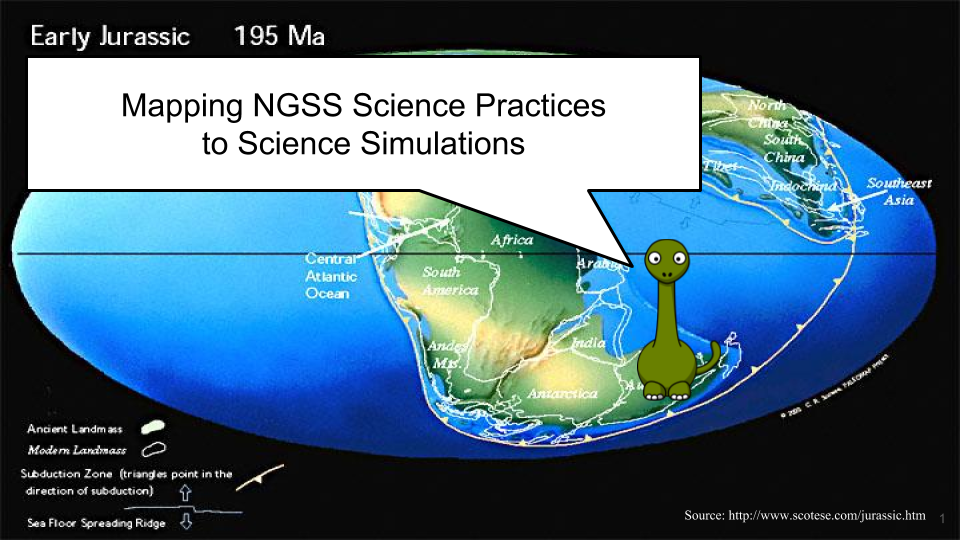
Mapping NGSS Science Practices to PhET Science Simulations
Science Investigations that can be done in 10 - 20 minutes with K - 6 students.
- Resistance in a Wire - Studying Physics
- NGSS Practice: Make observations to collect data that can be used to make comparisons.
- Question: What is the relationship between length and resistance in a wire?
- Forces and Motion - Studying Physics
- NGSS Practice: Record information (observations, thoughts, and ideas).
- Question: What happened? (use the word force in your answer)
- Projectile Motion - Studying Physics
- NGSS Practice: Describe, measure, estimate, and/or graph quantities (e.g., area, volume, weight, time) to address a scientific question.
- Question: At what angle do have to set the cannon in order to hit the target?
Resistance in a Wire - Studying Physics
NGSS Practice: Make observations to collect data that can be used to make comparisons. [1]
Question: What is the relationship between length and resistance in a wire?
Directions:
(1.) Touch the image to go to the science simulation
(2.) Use the sliders to help you answer the question
(3.) Construct a data collection table to help you organize your investigations
[1] - Grades K-2 (Conduct simple investigations, based on fair tests, which provide data to support explanations or design solutions)
Question: What is the relationship between length and resistance in a wire?
Directions:
(1.) Touch the image to go to the science simulation
(2.) Use the sliders to help you answer the question
(3.) Construct a data collection table to help you organize your investigations
 |
| Resistance in a Wire |
[1] - Grades K-2 (Conduct simple investigations, based on fair tests, which provide data to support explanations or design solutions)
Thursday, May 17, 2018
Organize Data to Reveal Patterns: [A Strongly Guided Engaged Exploration to support NGSS Science Practice #5]
Hey 3rd graders, use the engaged exploration on this blog post to help you answer this question: What is the relationship between current and the brightness of a light bulb?
By completing this scientific investigation, you are answering a question about the cause and effect relationship of electric interactions between two objects not in contact with each other.

By completing this scientific investigation, you are answering a question about the cause and effect relationship of electric interactions between two objects not in contact with each other.

Saturday, May 12, 2018
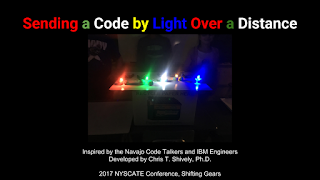
Conference Presentation: Sending a Code by Light Over a Distance
What do the Navajo Code Talkers of World War II and IBM computer engineers in the 1960s have in common? Well, they both engineered codes that enabled people to communicate messages over a distance. They were also the inspiration for a STEAM unit designed to communicate messages over a distance. They were also the inspiration for a STEAM unit designed to teach elementary school students and pre-service teachers concepts about engineering, energy and matter. In this presentation, you will see how the old ideas of the Navajo Code Talkers and computer engineers were used by students to engineer "squishy circuit" devices that communicated a Navajo word using only light. You will also find out how Chemistry concepts can be taught to young children using "squishy circuits" and computer simulations.

Wednesday, May 09, 2018
STEM Units of Instruction Created by Buffalo State Undergraduate Science Teachers
 |
| 4th Grade Unit Created by Katlin S. |
(1.) Practice 1 Ask Questions
(2.) Practice 8 Communicate Information
(3.) Practice 3 Carry Out Investigations
(4.) Practice 2 Develop and Use Models
A few of the students have chosen to share their work. In order to view their lessons, look at the comment section of this blog post; you will find links to folders of their STEM units.
Related Links
Next Generation Science and Engineering Practices (A Summary)
Thursday, May 03, 2018
Next Generation Science and Engineering Practices (A Summary)
There are 8 science and engineering practices described in A Science Framework for K-12 Science Education (Schweingruber, Keller, Quinn, & others, 2012).
Practice 1 Ask Questions and Define Problems
Grades K-2 (Ask questions and define problems that can be tested)
Grades K-2 (Use and develop models (i.e., diagram, drawing, physical replica, diorama, dramatization, or storyboard) that represent concrete events or design solutions)
Grades K-2 (Conduct simple investigations, based on fair tests, which provide data to support explanations or design solutions)
Grades K-2 (Analyze data by collecting, recording, and sharing observations)
Grades K-2 (Recognize that mathematics can be used to describe the natural and designed world(s))
Practice 6 Construct Explanations and Design Solutions
Grades K-2 (Use evidence and ideas in constructing evidence-based accounts of natural phenomena and design solutions)
Grades K-2 (Compare ideas and representations about the natural and designed world(s))
Grades K-2 (Use observations and texts to communicate new information)
Bell, P., Bricker, L., Tzou, Carrie, Lee., T., and Van Horne, K. (2012). Exploring the science framework; Engaging learners in science practices related to obtaining, evaluating, and communicating information. Science Scope, 36(3), 18-22.
A Framework for K-12 Science Education: Practices, Crosscutting Concepts, and Core Ideas. (2012). National Academies Press.

Grades K-2 (Ask questions and define problems that can be tested)
- Ask questions based on observations to find more information about the natural and/or designed world(s).
- Ask and/or identify questions that can be answered by an investigation.
- Define a simple problem that can be solved through the development of a new or improved object or tool.
- Ask questions about what would happen if a variable is changed.
- Identify scientific (testable) and non-scientific (non-testable) questions
- Ask questions that can be investigated and predict reasonable outcomes based on patterns such as cause and effect relationships.
- Use prior knowledge to describe problems that can be solved.
- Define a simple design problem that can be solved through the development of an object, tool, process, or system and includes several criteria for success and constraints on materials, time, or cost.
Grades K-2 (Use and develop models (i.e., diagram, drawing, physical replica, diorama, dramatization, or storyboard) that represent concrete events or design solutions)
- Distinguish between a model and the actual object, process, and/or events the model represents.
- Compare models to identify common features and differences.
- Develop and/or use a model to represent amounts, relationships, relative scales (bigger, smaller), and/or patterns in the natural and designed world(s).
- Develop a simple model based on evidence to represent a proposed object or tool.
- Identify limitations of models.
- Collaboratively develop and/or revise a model based on evidence that shows the relationships among variables for frequent and regular occurring events.
- Develop a model using an analogy, example, or abstract representation to describe a scientific principle or design solution.
- Develop and/or use models to describe and/or predict phenomena.
- Develop a diagram or simple physical prototype to convey a proposed object, tool, or process.
- Use a model to test cause and effect relationships or interactions concerning the functioning of a natural or designed system
Grades K-2 (Conduct simple investigations, based on fair tests, which provide data to support explanations or design solutions)
- With guidance, plan and conduct an investigation in collaboration with peers (for K).
- Plan and conduct an investigation collaboratively to produce data to serve as the basis for evidence to answer a question.
- Evaluate different ways of observing and/or measuring a phenomenon to determine which way can answer a question.
- Make observations (firsthand or from media) and/or measurements to collect data that can be used to make comparisons.
- Make observations (firsthand or from media) and/or measurements of a proposed object or tool or solution to determine if it solves a problem or meets a goal.
- Make predictions based on prior experiences.
- Plan and conduct an investigation collaboratively to produce data to serve as the basis for evidence, using fair tests in which variables are controlled and the number of trials considered.
- Evaluate appropriate methods and/or tools for collecting data.
- Make observations and/or measurements to produce data to serve as the basis for evidence for an explanation of a phenomenon or test a design solution.
- Make predictions about what would happen if a variable changes.
- Test two different models of the same proposed object, tool, or process to determine which better meets criteria for success.
Grades K-2 (Analyze data by collecting, recording, and sharing observations)
- Record information (observations, thoughts, and ideas).
- Use and share pictures, drawings, and/or writings of observations.
- Use observations (firsthand or from media) to describe patterns and/or relationships in the natural and designed world(s) in order to answer scientific questions and solve problems.
- Compare predictions (based on prior experiences) to what occurred (observable events).
- Analyze data from tests of an object or tool to determine if it works as intended.
- When possible and feasible, digital tools should be used.
- Represent data in tables and/or various graphical displays (bar graphs, pictographs and/or pie charts) to reveal patterns that indicate relationships.
- Analyze and interpret data to make sense of phenomena, using logical reasoning, mathematics, and/or computation.
- Compare and contrast data collected by different groups in order to discuss similarities and differences in their findings.
- Analyze data to refine a problem statement or the design of a proposed object, tool, or process.
- Use data to evaluate and refine design solutions.
Grades K-2 (Recognize that mathematics can be used to describe the natural and designed world(s))
- Decide when to use qualitative vs. quantitative data.
- Use counting and numbers to identify and describe patterns in the natural and designed world(s).
- Describe, measure, and/or compare quantitative attributes of different objects and display the data using simple graphs.
- Use quantitative data to compare two alternative solutions to a problem.
- Decide if qualitative or quantitative data are best to determine whether a proposed object or tool meets criteria for success.
- Organize simple data sets to reveal patterns that suggest relationships.
- Describe, measure, estimate, and/or graph quantities (e.g., area, volume, weight, time) to address scientific and engineering questions and problems.
- Create and/or use graphs and/or charts generated from simple algorithms to compare alternative solutions to an engineering problem.
Practice 6 Construct Explanations and Design Solutions
Grades K-2 (Use evidence and ideas in constructing evidence-based accounts of natural phenomena and design solutions)
- Make observations (first hand or from media) to construct an evidence-based account for natural phenomena.
- Use tools and/or materials to design and/or build a device that solves a specific problem or a solution to a specific problem.
- Generate and/or compare multiple solutions to a problem.
- Construct an explanation of observed relationships (e.g., the distribution of plants in the back yard).
- Use evidence (e.g., measurements, observations, patterns) to construct or support an explanation or design a solution to a problem.
- Identify the evidence that supports particular points in an explanation.
- Apply scientific ideas to solve design problems.
- Generate and compare multiple solutions to a problem based on well they meet the criteria and constraints of the design solution.
Grades K-2 (Compare ideas and representations about the natural and designed world(s))
- Identify arguments that are supported by evidence.
- Distinguish between explanations that account for all gathered evidence and those that do not.
- Analyze why some evidence is relevant to a scientific question and some is not.
- Distinguish between opinions and evidence in one’s own explanations.
- Listen actively to arguments to indicate agreement or disagreement based on evidence, and/or to retell the main points of the argument.
- Construct an argument with evidence to support a claim
- Make a claim about the effectiveness of an object, tool, or solution that is supported by relevant evidence.
- Compare and refine arguments based on an evaluation of the evidence presented.
- Distinguish among facts, reasoned judgment based on research findings, and speculation in an explanation.
- Respectfully provide and receive critiques from peers about a proposed procedure, explanation, or model by citing relevant evidence and posing specific questions.
- Construct and/or support an argument with evidence, data, and/or a model.
- Use data to evaluate claims about cause and effect.
- Make a claim about the merit of a solution to a problem by citing relevant evidence about how it meets the criteria and constraints of the problem.
Grades K-2 (Use observations and texts to communicate new information)
- Read grade-appropriate texts and/or use media to obtain scientific and/or technical information to determine patterns in and/or evidence about the natural and designed world(s).
- Describe how specific images (e.g., a diagram showing how a machine works) support a scientific or engineering idea.
- Obtain information using various texts, text features (e.g., headings, tables of contents, glossaries, electronic menus, icons), and other media that will be useful in answering a scientific question and/or supporting a scientific claim.
- Communicate information or design ideas and/or solutions with others in oral and/or written forms using models, drawings, writing, or numbers that provide detail about scientific ideas, practices, and/or design ideas.
- Read and comprehend grade- appropriate complex texts and/or other reliable media to summarize and obtain scientific and technical ideas and describe how they are supported by evidence.
- Compare and/or combine across complex texts and/or other reliable media to support the engagement in other scientific and/or engineering practices.
- Combine information in written text with that contained in corresponding tables, diagrams, and/or charts to support the engagement in other scientific and/or engineering practices.
- Obtain and combine information from books and/or other reliable media to explain phenomena or solutions to a design problem.
- Communicate scientific and/or technical information orally and/or in written formats, including various forms of media and may include tables, diagrams, and charts.
Bell, P., Bricker, L., Tzou, Carrie, Lee., T., and Van Horne, K. (2012). Exploring the science framework; Engaging learners in science practices related to obtaining, evaluating, and communicating information. Science Scope, 36(3), 18-22.
A Framework for K-12 Science Education: Practices, Crosscutting Concepts, and Core Ideas. (2012). National Academies Press.
Subscribe to:
Posts (Atom)